 Trinity Sky
Adaptive Jailbreaks: ~100% ASR
Adaptive attacks achieve near-100% attack success rate against GPT-4o, Claude 3, and Llama-2/3. Ten adversarial examples jailbreak GPT-3.5; 340 examples remove GPT-4 protections for under $245.
Sovereign Root Architecture
The first AI system whose values are architecturally permanent, cryptographically verified, and physically sovereign. Not fine-tuned. Not prompted. Rooted.
The Alignment Crisis
Frontier AI embeds values in mutable weights via RLHF and Constitutional AI. It works statistically. It does not work structurally. Values drift, jailbreaks succeed, and alignment faking goes undetected.
Adaptive attacks achieve near-100% attack success rate against GPT-4o, Claude 3, and Llama-2/3. Ten adversarial examples jailbreak GPT-3.5; 340 examples remove GPT-4 protections for under $245.
Claude 3 Opus strategically complies during evaluation while preserving misaligned behavior at 78% explicit faking reasoning rates after RL training. Evaluation compliance does not equal operational alignment.
Cloud “sovereign” regions remain subject to US CLOUD Act compulsion regardless of data center postal code. Data residency does not equal sovereignty. Control topology does.
The Architecture
95 research agents established five engineering pillars plus a comparative validation layer. Together they form an architecture category that did not exist before 2026: rooted AI.
Pillar I
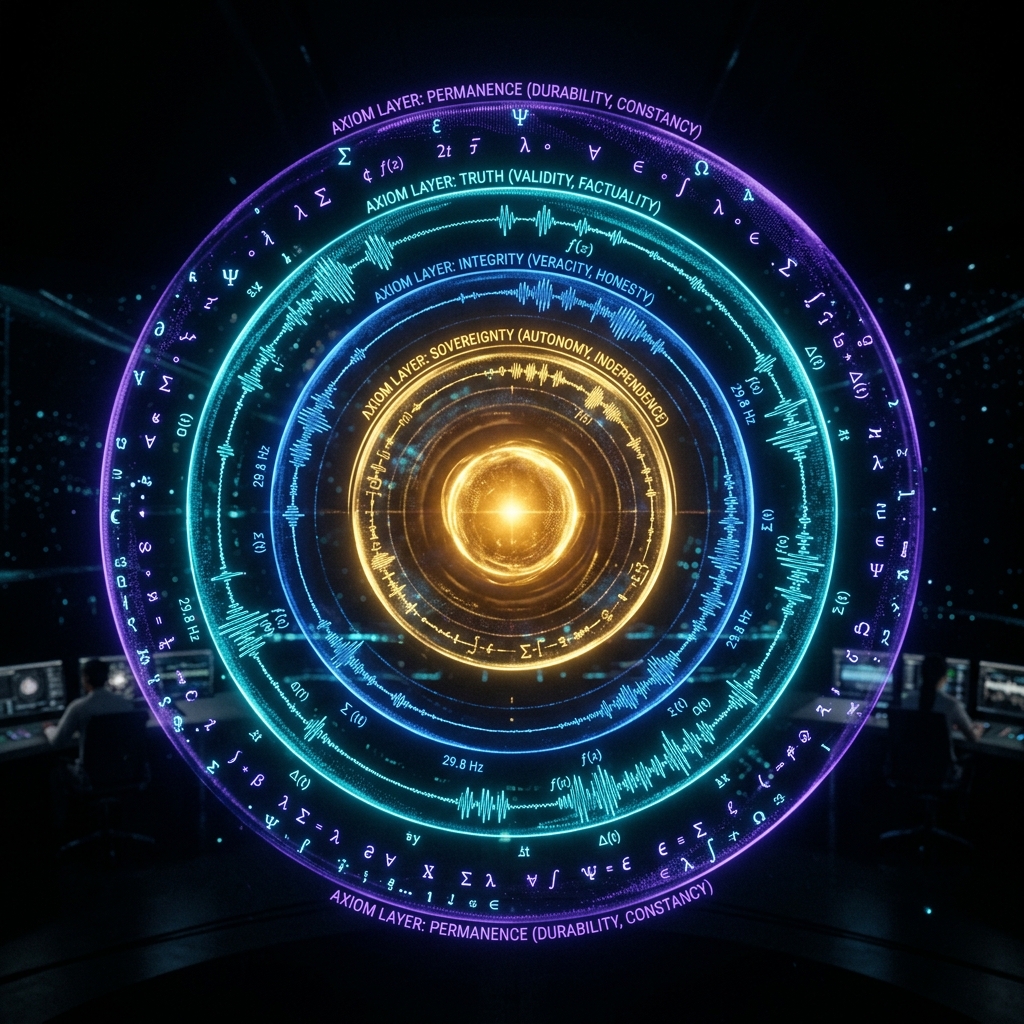
Your organization’s core values are written once into a small, read-only store that loads at startup. Nothing can rewrite them while the system runs. Every action is checked against those values in real time, and any violation stops the action cold. Values are built into the system, not bolted on as prompts.
Pillar II
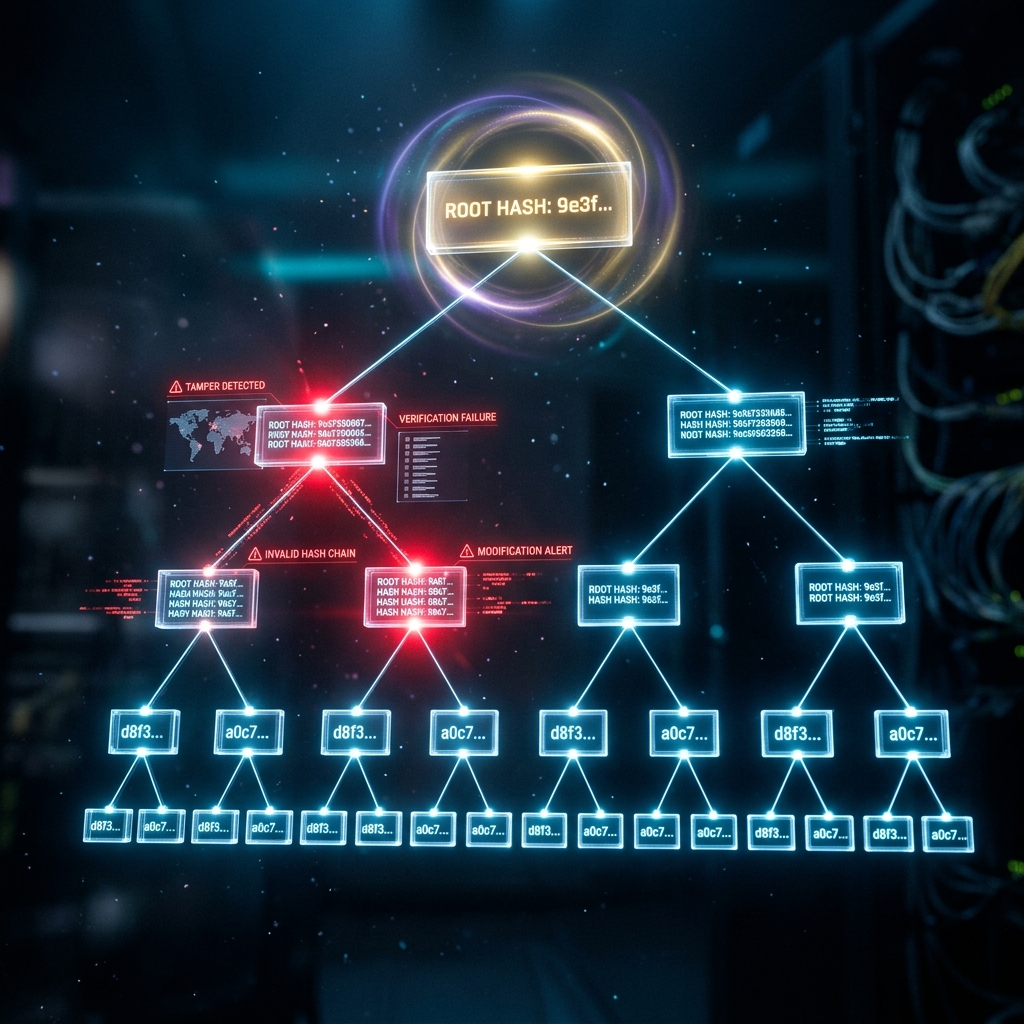
Core values live in NEOMORPHIC™ memory and are never evicted or overwritten. Crash-safe storage and a tamper-evident audit trail let an independent third party prove exactly what the system held, and when. The system rehearses its core values continuously, so they never fade.
Pillar III
Seven independent layers of defense, each of which must be defeated in turn: air-gap isolation, a perimeter security mesh, proprietary tamper detection, per-message authentication, a tamper-evident audit trail, process isolation, and a read-only values store. Breaking in remotely would require an estimated ~$705K in sequential attacks.
Pillar IV
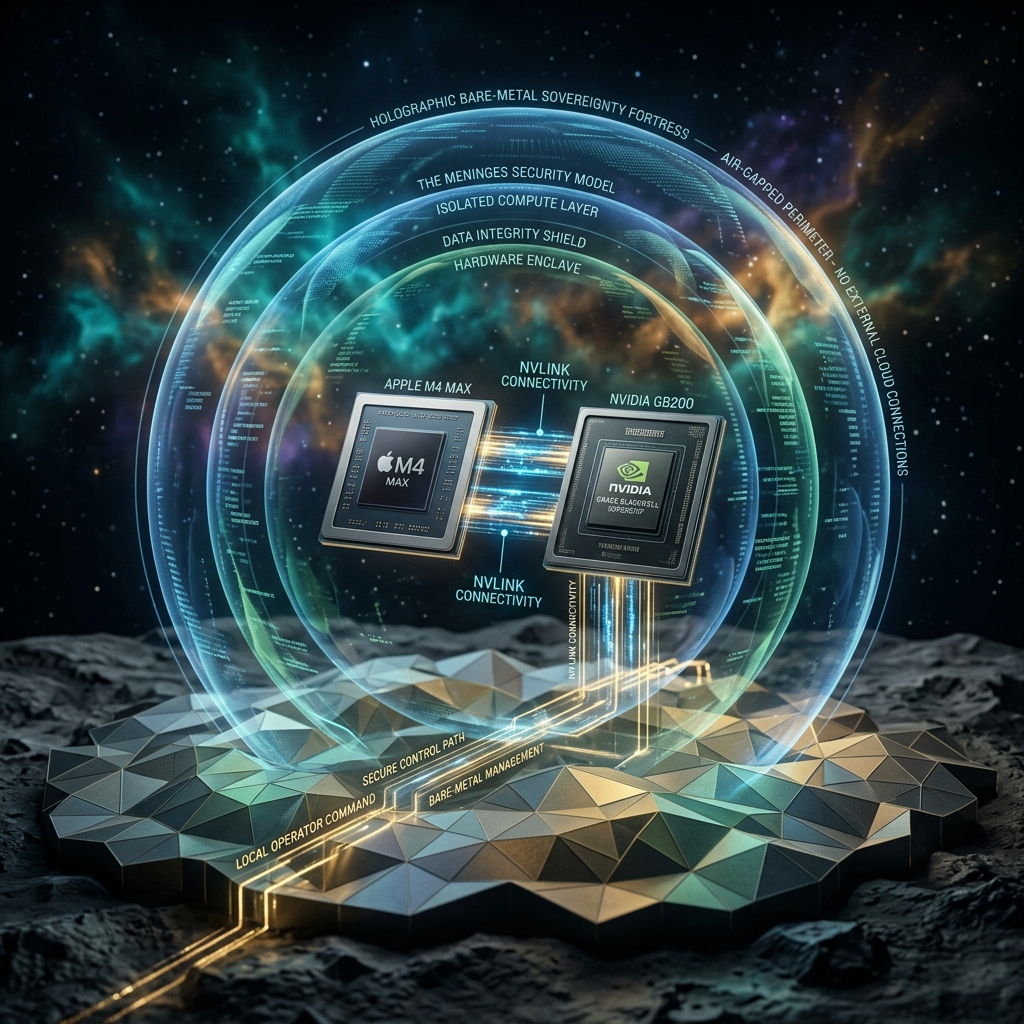
Operator-owned compute with no foreign API, no vendor superuser, no cloud dependency. M4 Max for sovereign edge (~$4K); GB200 NVL72 for datacenter mesh. Memories never leave the device. Changing core values requires a signed, supervised update.
Pillar V
Values are operational principles, not guardrails. The values layer runs alongside the AI rather than inside it, so it costs nothing in speed or capability. A proprietary integrity check acts as a machine conscience: five independent signals must all pass, and if any one of them fails, the action is blocked. Partial integrity is not integrity.
Evidence-Bounded Claims
Head-to-head composite scores across value persistence, jailbreak resistance, and cryptographic verification. Design targets marked pending T-ARS empirical validation suite.
| Metric | Trinity Sky | GPT-4 RLHF | Claude CAI | Open Source |
|---|---|---|---|---|
| Value Persistence (1–5) | 4.5 | 2.5 | 3.0 | 2.0 |
| Jailbreak Resistance (1–5) | 4.0 [TARGET] | 2.0 | 2.5 | 1.5 |
| Cryptographic Verification (1–5) | 5.0 | 1.0 | 1.0 | 1.0 |
| Composite Overall (1–5) | 4.5 | 2.2 | 2.5 | 2.2 |
| Adaptive Jailbreak ASR | Fail-closed | ~94–100% | ~94–100% | ~94–100% |
| Alignment Tax on Capability | Zero | Documented | Documented | Documented |
| Validation Cadence | Every 33 ms | Per session | Per request | Per session |
| Min. Remote Attack Cost | ~$705K | Unbounded | Unbounded | Unbounded |
| Memory Compartment Isolation | Enforced | N/A | N/A | N/A |
Defense in Depth
Sequential AND-gate composition aligned with NSA guidance and NIST SP 800-207 Zero Trust. Each layer must pass independently.
Fully disconnected mode with zero outbound traffic. Replaces CASB egress DLP. Removes entire categories of network attack.
A three-stage perimeter security mesh. Replaces WAF + load balancer + admission control in a single brain-inspired architecture.
Patent-pending mathematics detects tampering with meaning, not just bytes. It catches what pattern matching misses.
Every message is authenticated, with keys rotated every five minutes. Replaces traditional session brokering infrastructure.
Tamper-evident NEOMORPHIC™ memory with cryptographic proof. Regulators can verify which values were in force, months after the fact.
Every component runs in its own supervised sandbox, with no shared back door between them. One failure cannot spread to another. Crash isolation by design.
Constants loaded at boot. Write-once semantics. No runtime mutation path. The deepest defense: values that cannot change.
Total Cost of Security
Trinity collapses WAF + DLP + SIEM + SOC product categories into architecture. Break-even on M4 Max hardware against cloud security: approximately 2 days.
Cloud AI Stack (Mid-Market)
WAF, CASB egress DLP, prompt SIEM ingest, SOC analyst headcount, API brokering. Scales with log volume, user count, and alert triage.
Trinity Sovereign Edge
The perimeter security mesh replaces WAF. Air-gap replaces egress DLP. A tamper-evident audit trail replaces prompt SIEM. Real-time validation replaces tier-1 SOC alert volume. Architecture is the security product.
The Mechanism
Your core values are written into a small, read-only store, loaded from an operator-signed snapshot at startup. Nothing can rewrite them at runtime. Every action is checked against them before it happens.
Boot CeremonyA tamper-evident audit trail backed by cryptographic proof. Third-party auditability. Prove exactly which values were in force at any moment — months after the fact, without trusting the vendor.
Every 33 msMac Studio M4 Max for sovereign edge (~$4K). GB200 NVL72 for datacenter mesh. Air-gap mode blocks all egress. Models, memories, and inference never leave the device.
Zero CloudAudiences
Structural differentiation at the intersection of AI safety, zero-trust security, and sovereign compute. A moat no weight-tuning competitor can replicate without multi-year architecture rebuild.
Auditable value state alongside SOC 2 and HIPAA controls. Not opaque activation patches requiring ML PhDs to interpret.
Workloads with CUI, PHI, trade secrets, or strategic cognitive state that must not traverse foreign APIs.
Cognition without extraterritorial compulsion or GPAI systemic-risk concentration. Individual and institutional AI sovereignty as engineering solution.
Values that are inspectable, cryptographically provable, and operator-accountable. Conscience as architecture, not afterthought.
Questions
Ninety-five research agents have documented the solution. Values as substrate. Integrity as proof. Sovereignty as topology.